
This year, Cornell University will host the sixth annual XR Access Symposium, an annual conference that brings together influential figures from advocacy, academia, and business to discuss and resolve the most urgent issues regarding extended reality accessibility. The focus will be on Insights from XR Assistive Technology: how can we learn from technologies aimed at assisting disabled people in order to make mainstream XR more accessible? The two-day conference will take place June 6-7 on Cornell Tech’s campus in New York City and will be broadcast online. We welcome you to join–you can register on Eventbrite to attend in person or online via Zoom.
Scholarship
Would you like to attend the Symposium in person but face hardship in paying the registration fee or traveling to New York? If so, please fill out the XR Access scholarship application by May 10th, 2024, at the latest. XR Access may be able to waive the registration fee and refund up to $400 of travel expenses, with receipts.
Volunteering
If you would like to volunteer at the Symposium, please complete this volunteer application. In addition to the host’s heartfelt gratitude, volunteers receive a complimentary event registration and an XR Access T-shirt.
If you have any questions, please reach out to info@xraccess.org.
Tag Archives: news
Revolutionizing Healthcare: Cornell’s VR Team Shines at International Hackathon with Insomnia Intervention
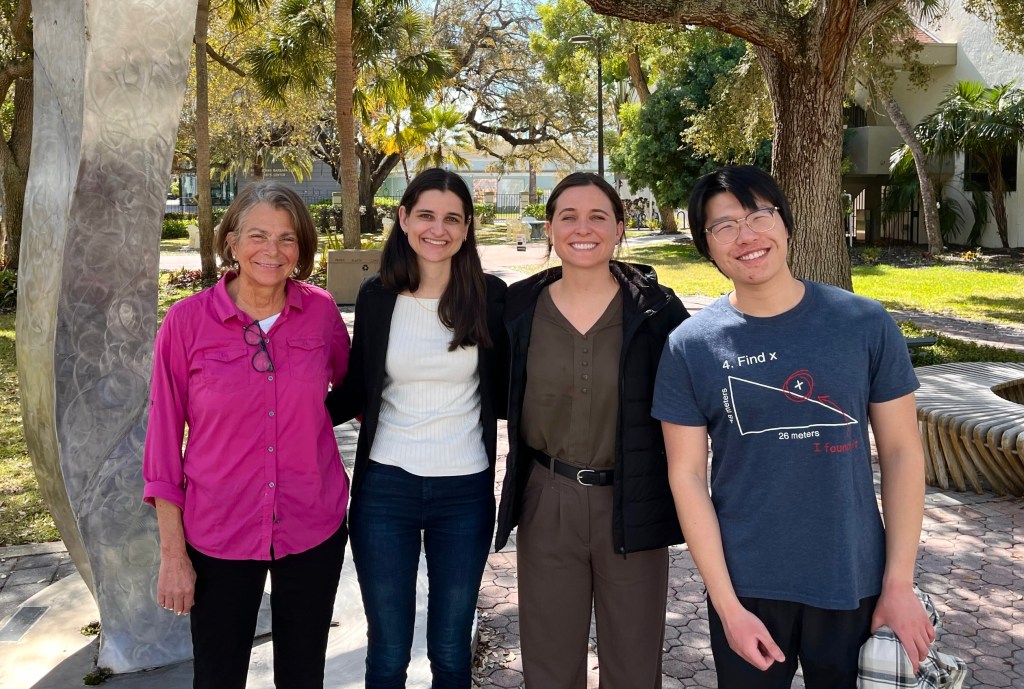
Pictured left to right: Dr. JoAnn Difede, Mariel Emrich, Stephanie Belina, and Fuyu Wang.
In February of this year, the International Virtual Reality Healthcare Association hosted its very first Healthcare Hackathon Invitational in Tampa Bay, Florida. The event aimed to encourage innovation and provide an open platform for immersive technologies in healthcare. The hackathon was open to undergraduate and graduate students from universities across the globe. Representing Cornell University were Ph.D. and graduate students Mariel Emrich, Stephanie Belina, and Fuyu Wang, accompanied by Dr. JoAnn Difede. Their virtual reality intervention for insomnia, with the military as a case study population, presented innovative solutions for sleep therapy that earned them second place at the IVRHA’s Hackathon. We’re proud to congratulate the Cornell University team, including our Virtual Embodiment Lab’s PhD Student Stephanie Belina, for their accomplishment and contribution to healthcare technology!
 the Virtual Embodiment Lab
You must be logged in to post a comment.