Co-authors include Mehrnaz Sabet, M.S. ’23, doctoral student in Information Science; Angel Hsing-Chi Hwang, Ph.D. ’23, assistant professor of Communication at the University of Southern California; Hal Rives ’21, current medical student at Temple University; Qinyue Yu ’23; and Ke Wu ’23.
This past summer, the Virtual Embodiment Lab at Cornell University welcomed two undergraduate Research Experience for Undergraduates (REU) students—Shayla Reid (’27, Mechanical Engineering) and Nalini Agnirothi (’28, Computer Science and Astronomy)—under the mentorship of Ph.D. student Kevin Martinez. Together, they spent ten weeks investigating how people connect through motion and speech in immersive virtual environments.
Left to right: Nalini Agnihotri, Shayla Reid, and Kevin Martinez pose in the VEL.
Their project, called the social leading study, examined communication between two people in a networked virtual setting. Each pair of participants engaged in a brief debate while connected through VR.
Reid and Agnirothi were deeply involved in designing and running the experiment. “Nalini and I were the coders,” Reid said. “We were modifying the Unity virtual environment that the participants would be in.” They added features such as a color wheel “to make the experience more personable and customizable.” Beyond coding, they recruited participants across campus, helped them get set up in headsets, and later analyzed their movement data. A paper describing the experiment is currently under review, and both Reid and Agnirothi are authors on that paper.
One of the most memorable experiences for both Reid and Agnirothi was attending the XR Access Symposium at Cornell Tech as volunteers. “We got to see other people in the VR accessibility field, try out different equipment, and learn more about how VR can be applied to accessibility. We even got to test a prototype for the virtual conferencing tool to make it more interactive,” said Reid.
Agnirothi described the unique experiences they had at the conference. “It was really cool learning about new projects like Meta’s ARIA glasses, which are designed for people with low vision. They showed how someone could finally navigate a grocery store independently. Seeing technology aimed at accessibility made me realize how broad this field really is.”
Shayla Reid (first row, center) and Nalini Agnihotri (bottom row, far right) snap a pic with the other XR Access conference volunteers.
For Reid, the REU experience offered a new perspective on design and accessibility. “In one of my mechanical design classes, we talked about human-centered design—how what we build needs to be accessible for everybody,” she said. “Working with VR headsets and controllers helped me see how something that feels intuitive to me might not be for someone else. It changed how I think about designing interfaces.”
“As a mechanical engineer, we usually just sit behind the desk building things,” she said. “So it was nice to actually go out and talk to people.” She also appreciated the creative space the lab provided: “I liked how Professor Won and the grad students gave us room to explore what we liked. It made me feel like an actual researcher, not just an assistant.”
For Agnirothi, the summer marked her first deep dive into research. “I was hoping to get experience with something related to my field and to learn how research is conducted,” Agnirothi said. “Coming into the lab, I was just hoping for experience, but it was actually incredible. I got to see so many different parts of research.” She described the experience as “essentially like interning to be a Ph.D. student,” since she and Reid worked closely with Ph.D. student Kevin Martinez every day.
Both students agreed that the mentorship and lab culture shaped their experience. “The lab culture is so welcoming and supportive,” Agnirothi said. “Everyone—from Professor Won to the grad students—was kind, understanding, and always willing to help. It made research feel exciting instead of intimidating.”
Thank you to our PhD candidates, graduate researchers, and undergraduate RAs who collaborated on various VR programs and projects this semester. At our final all-hands meeting, we enjoyed eating pizza and pupusas and chatting with Dr. Jessica Szczuka from the University of Duisburg-Essen, Germany, about her research on VR in sexual and interpersonal relationships.
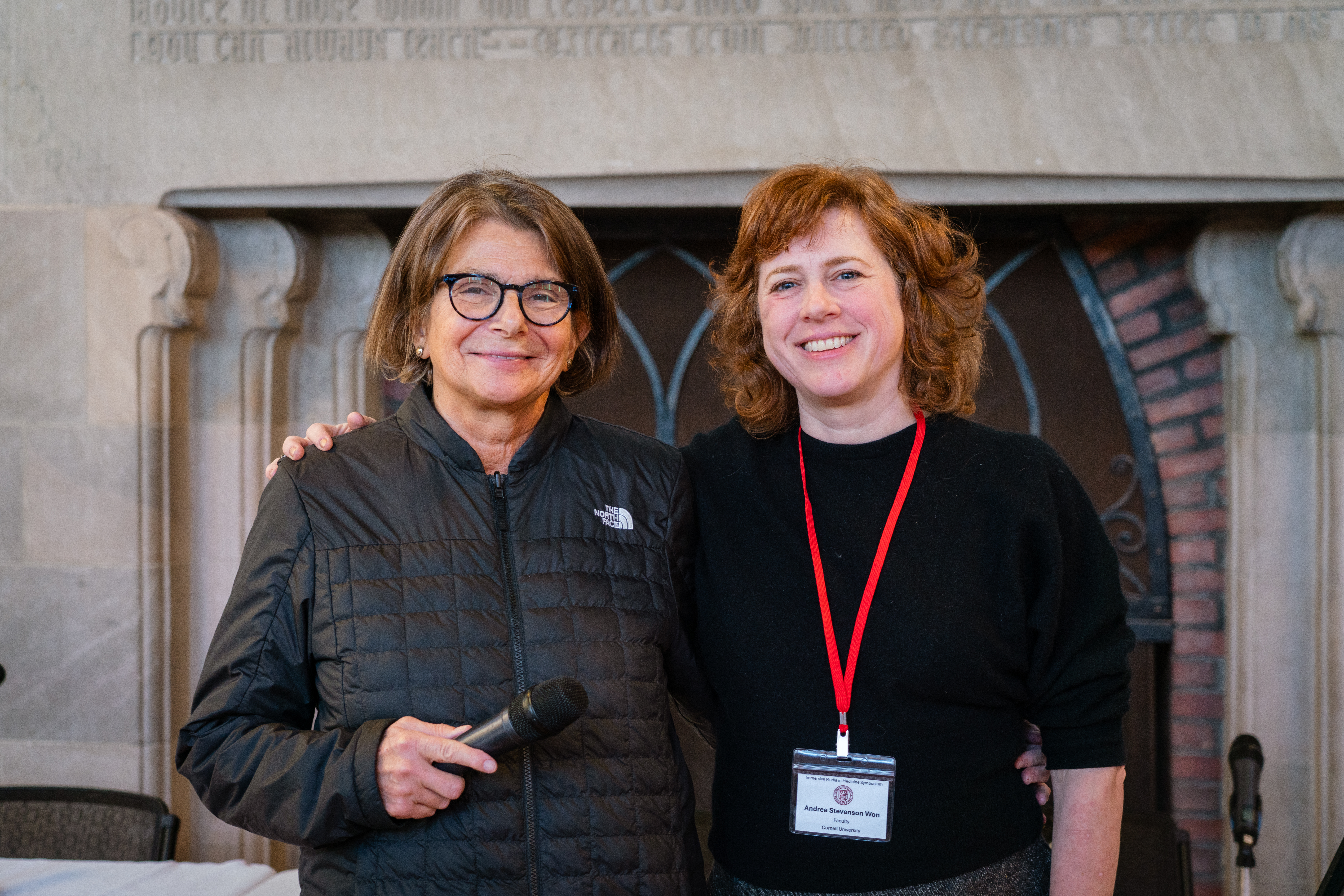
Pictured above: Dr. Andrea Stevenson Won and Dr. Jessica Szczuka
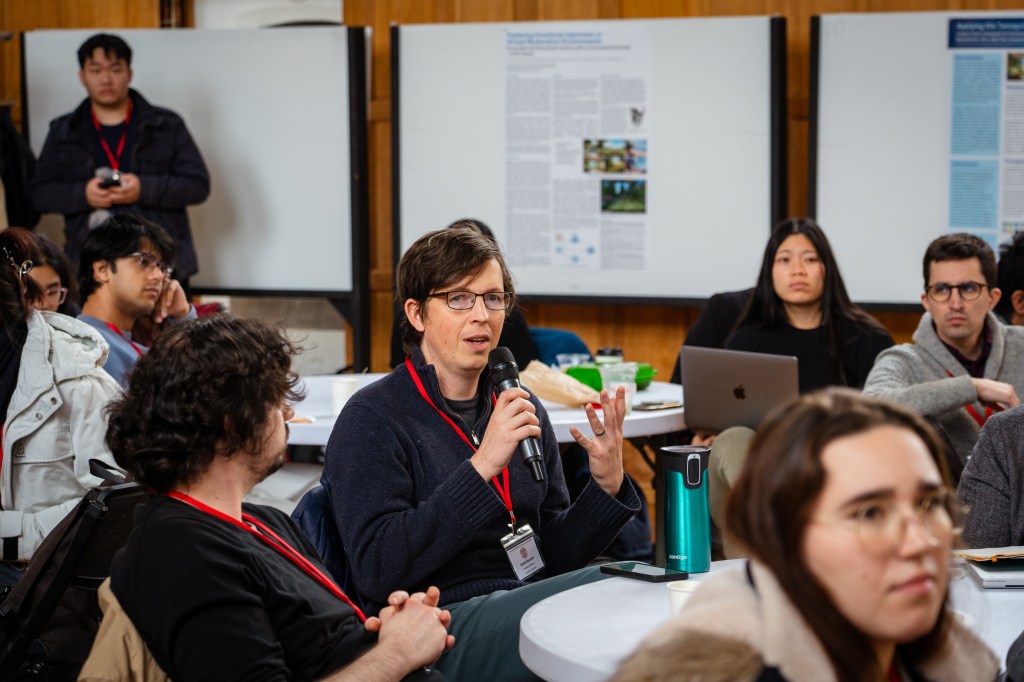
The Immersive Media in Medicine Symposium took place December 12-13, 2024, and was co-hosted by co-directors Dr. JoAnn Difede and Dr. Andrea Stevenson Won. We look forward to engaging with all our attendees and showcasing our innovators.
The Virtual Embodiment Lab hosted a sweet sendoff for our postdoc, Miki Matsumuro, with homemade tart cherry pie and passionfruit bars. Miki has worked at the VEL since November of 2023 assisting on our teamwork research through development on VR projects such as MazeWorld and investigations on synchrony. Thank you, Miki, for your contributions to the team, and good luck at your new job at Honda!
Here’s a glance back to the first VEL meeting of the semester, where our team of PhD candidates, graduate researchers, and undergraduate RAs came together over pizza to bond and discuss goals for the semester. Postdoctoral candidate Miki Matsumoru also demonstrated her VR project, “MazeWorld” (preview here).
This year, Cornell University will host the sixth annual XR Access Symposium, an annual conference that brings together influential figures from advocacy, academia, and business to discuss and resolve the most urgent issues regarding extended reality accessibility. The focus will be on Insights from XR Assistive Technology: how can we learn from technologies aimed at assisting disabled people in order to make mainstream XR more accessible? The two-day conference will take place June 6-7 on Cornell Tech’s campus in New York City and will be broadcast online. We welcome you to join–you can register on Eventbrite to attend in person or online via Zoom.
Scholarship
Would you like to attend the Symposium in person but face hardship in paying the registration fee or traveling to New York? If so, please fill out the XR Access scholarship application by May 10th, 2024, at the latest. XR Access may be able to waive the registration fee and refund up to $400 of travel expenses, with receipts.
Volunteering
If you would like to volunteer at the Symposium, please complete this volunteer application. In addition to the host’s heartfelt gratitude, volunteers receive a complimentary event registration and an XR Access T-shirt.
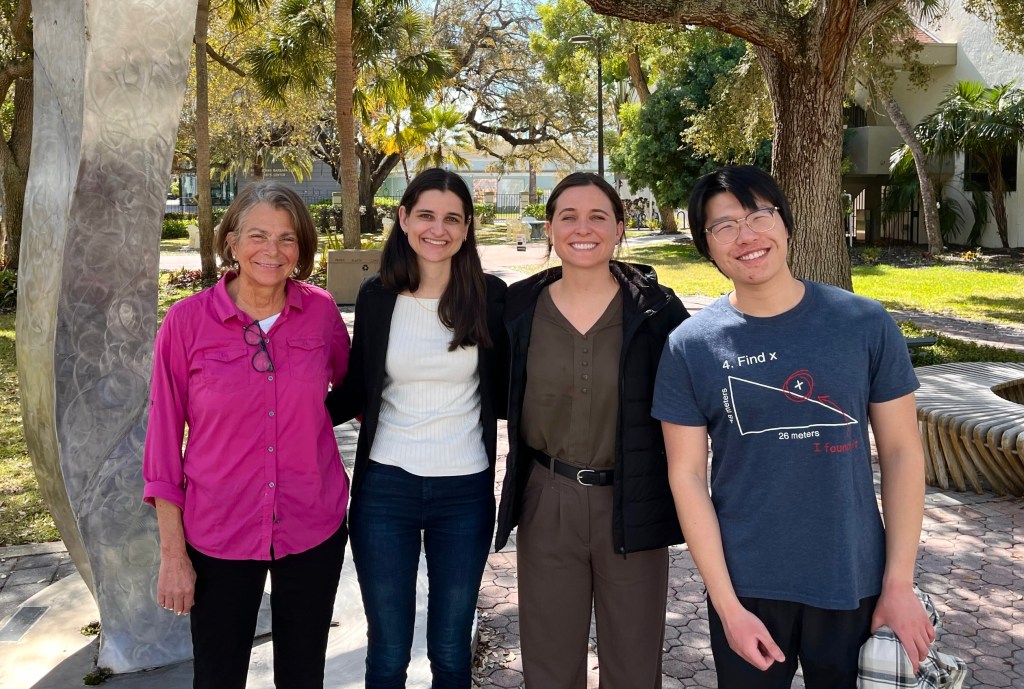
Pictured left to right: Dr. JoAnn Difede, Mariel Emrich, Stephanie Belina, and Fuyu Wang.
In February of this year, the International Virtual Reality Healthcare Association hosted its very first Healthcare Hackathon Invitational in Tampa Bay, Florida. The event aimed to encourage innovation and provide an open platform for immersive technologies in healthcare. The hackathon was open to undergraduate and graduate students from universities across the globe. Representing Cornell University were Ph.D. and graduate students Mariel Emrich, Stephanie Belina, and Fuyu Wang, accompanied by Dr. JoAnn Difede. Their virtual reality intervention for insomnia, with the military as a case study population, presented innovative solutions for sleep therapy that earned them second place at the IVRHA’s Hackathon. We’re proud to congratulate the Cornell University team, including our Virtual Embodiment Lab’s PhD Student Stephanie Belina, for their accomplishment and contribution to healthcare technology!
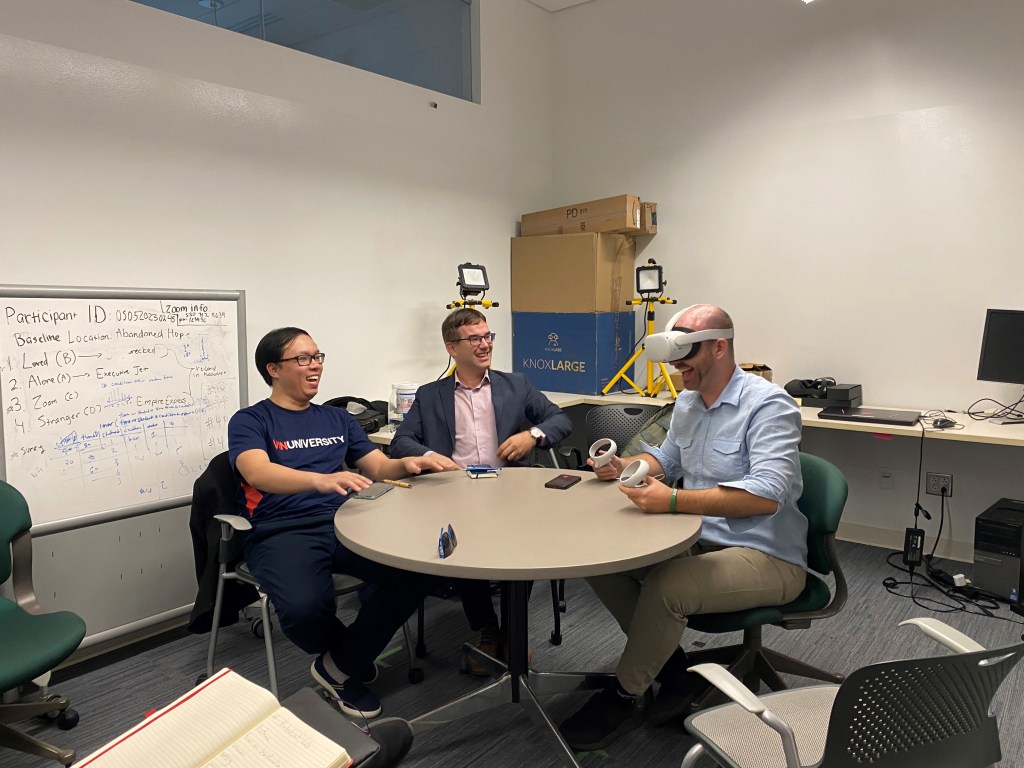
The Virtual Embodiment Lab recently welcomed four faculty from the VinUniversity College of Arts & Sciences to discuss the usage of XR technologies in communication. Visitors included Prof. Myles Lynch (Faculty and Senior Lecturer in the OASIS Program), Daniel Ruelle (Program Director of English & Communications, Director of Learning & Teaching Excellence Center), Stephen Lindhorst (Senior Academic English Lecturer) and Nhu Dinh Ngoc Anh (Andy) (Senior Lecturer in English). The Cornell-VinUniversity Project is a six-year initiative between Cornell University and Vingroup (a Vietnamese conglomerate) to establish the first private world-class university in Vietnam – VinUniversity.









 the Virtual Embodiment Lab
You must be logged in to post a comment.